Feeling Sad Needs Just as Much Space as Feeling Happy
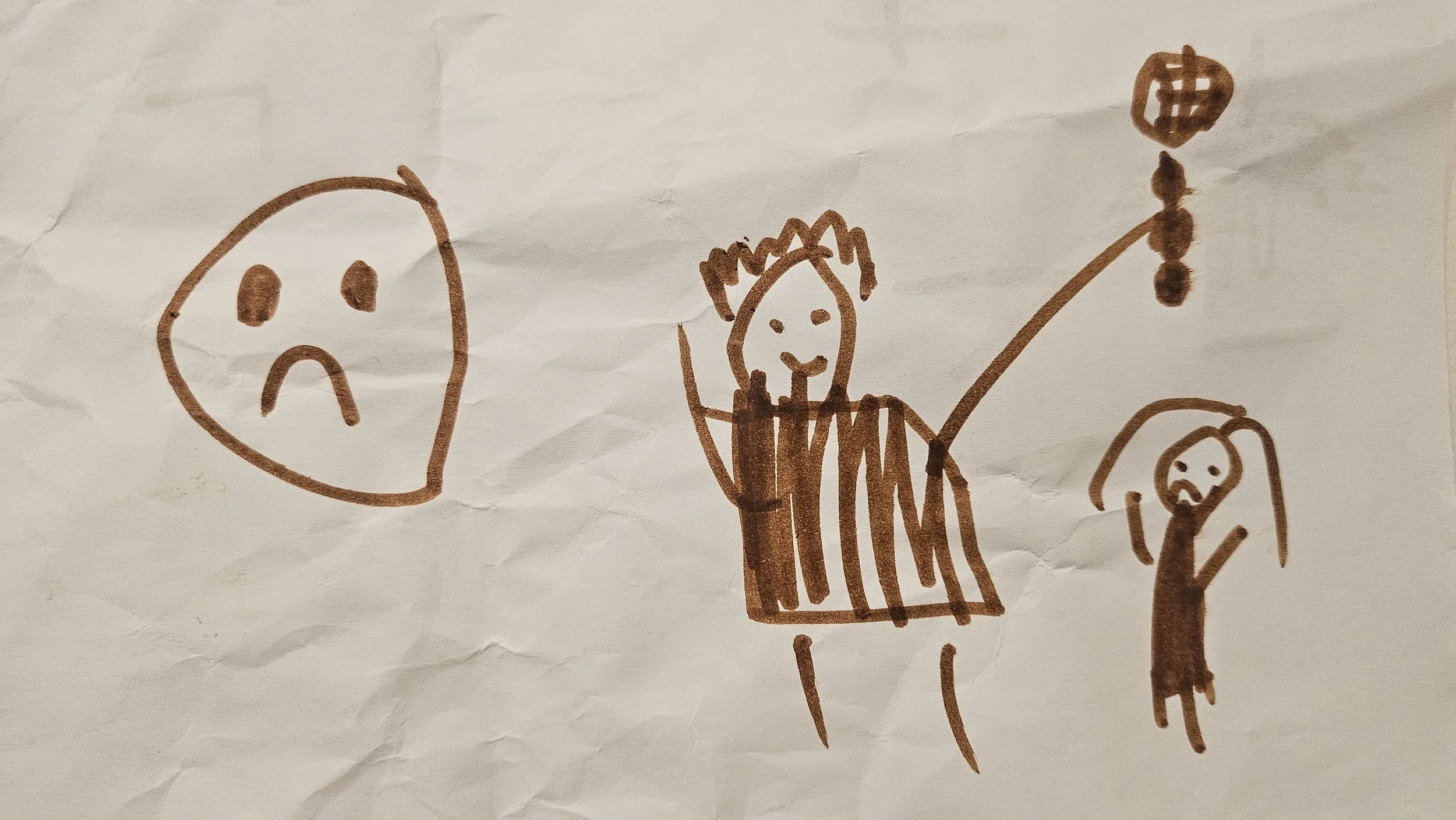
Drawing by Avi
One evening, our home was filled with the joyful chaos of a child’s imagination. Avi, my 5-year-old daughter, was running around with a toy microphone, singing, laughing, and absolutely living her best life. It was loud, vibrant, and completely unfiltered.
At the same time, we had visitors over. The adults were trying to have a conversation, but Avi’s concert made it nearly impossible to hear one another. After a few gentle requests to move her performance to another part of the house, Avi… being in her moment… ignored us.
Eventually, my husband stepped in and took the microphone away. Her bubble of happiness? Instantly popped.
Was it the right decision? Maybe. Maybe not. But in that moment, something had to give. And unfortunately for Avi, she lost her microphone.
She ran off, she was angry, she was sad! A few minutes later, she came back and silently handed me a drawing. It was a sad face, a dad holding a microphone and a sad girl. A little broken heart on paper. And honestly, it broke mine, too.
We didn’t take the microphone away to hurt Avi, we simply just needed her to respect the space and the people in it. But what struck me wasn’t the noise or the moment, it was that drawing.
A few days later, I found it again. That tiny, hand-drawn moment on paper and made me pause… Why do we treat sadness like it’s something to fix, rush through, or avoid altogether?
We live in a world that celebrates happiness as the default setting. We tell our kids to smile for photos, to “cheer up,” to “be good”, often equating goodness with being happy and calm. But what message are we really sending?
That sadness is wrong? That big emotions are inconvenient?
That if you're not happy, something must be broken?
Now, of course, prolonged sadness can be a sign of something deeper, like depression or anxiety, and that absolutely deserves attention and care.
But what I’m talking about here are the everyday emotions: disappointment, frustration, the sting of not getting your way. These are real. These are healthy. And these are necessary.
Because sadness builds resilience. Because setbacks teach empathy. Because when we learn to feel sadness fully, we also learn how to process, adapt, and grow.
We can't tell our children that only one half of the emotional spectrum is acceptable. Emotions aren’t “good” or “bad.” They just ARE. It’s our response to them that can be helpful or harmful.
After Avi gave us her drawing, we sat with her. We acknowledged her sadness and told her it was okay to feel upset and angry. We didn’t dismiss it. We didn’t sugarcoat it.
And Avi, in her own way, understood why her dad took the microphone away. More importantly, she knew her feelings were seen. She also learned that expressing emotions through words, drawings, or actions, is powerful and safe in our home.
That moment led to a beautiful, simple conversation where we both shared our perspectives: hers as a child, ours as parents.
Soon after, Avi got her microphone back… and the bubble of happiness returned. But this time, so did a little emotional growth for all of us.
Let’s stop rushing children and ourselves through sadness. Let’s give just as much space to the tears as we do to our laughs and smiles because every feeling matters.